别再逐条提示 AI 智能体了——去设计能驱动它们的「循环」,并学会在模型变强时向上堆叠循环以放大杠杆。这是 Latent Space / AINews 关于智能体编排的一段观点。
本文为 Latent Space / AINews 的观点摘录编译转载(英文原文)。
There’s a lot of “loop discourse” in the air:
- Steipete: “Here’s your monthly reminder that you shouldn’t be prompting coding agents anymore. You should be designing loops that prompt your agents.”
- Boris: “I don’t prompt Claude anymore. I write loops, the loops do the work.”
- Andrej on Autoresearch: To get the most out of the tools that have become available now you have to remove yourself as the bottleneck. You can’t be there to prompt the next thing. You need to take yourself outside. You have to arrange things such that they’re completely autonomous and the more you know how can you maximize your token throughput and not be in the loop. This is the goal and the name of the game now is to increase your leverage… I don’t want to be the researcher in the loop looking at results etc, I’m holding the system back. So the question is how do I refactor all the abstractions so that I’m not — I have to arrange it once and hit go.
We like this a lot, and people don’t realize how many loops we are already in:
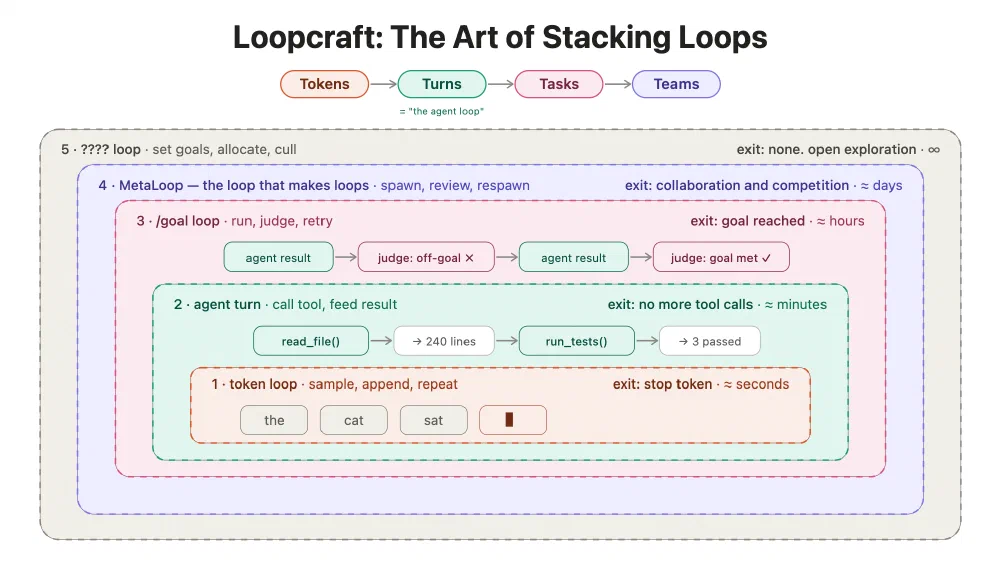
More minimalist, a smaller set of loops:
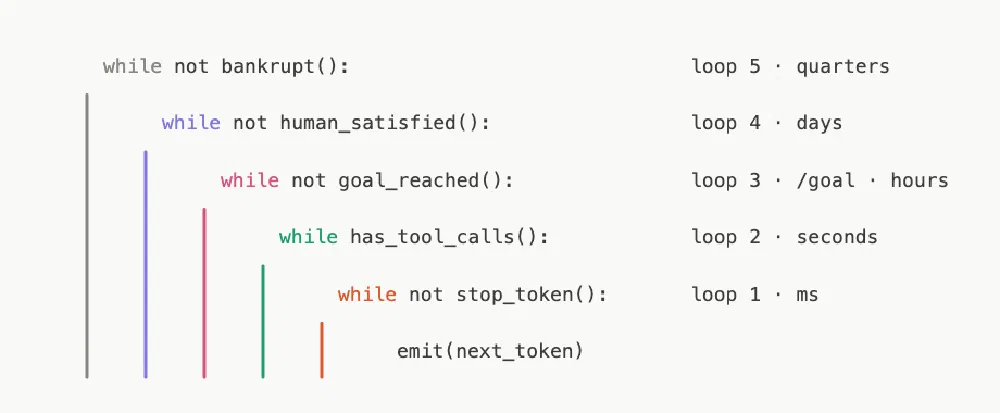
One might argue the entire game of the next century is to be able to stack loops as effectively as possible. In the early days of each phase, it will be valuable to know when to go DOWN a loop when things go wrong (for reliability)… but it will probably be more valuable to know how to go UP a loop as models improve (for leverage).
If you don’t figure out how to do this, don’t be salty when you lose to those that do.
Rich has his “Bitter Lesson” for models. We now have the Salty Lesson for agents:
Don’t fix things yourself, as you have done historically.
Instead, focus on systems that scale with more agents — like goals and orchestration.