Palantir is not just a data analytics tool, and not just a defense AI company. The right starting point is to understand Foundry, AIP, Apollo, and the Ontology as one architecture for enterprise data, AI, and action.
系列:Palantir Series 1 / 8
- 1 Palantir for Beginners: What Kind of Software Company Is It? 当前
- 2 Foundry: Why Palantir Turns a Data Platform Into an Operating System
- 3 Ontology: Why It Is the Core of Palantir
- 4 AIP: Why Enterprise Agents Cannot Be Just Chatbots
- 5 Apollo: Why Continuous Delivery Is a Palantir Advantage
- 6 Use Cases: How Palantir Lands in Manufacturing, Healthcare, Energy, and Defense
- 7 Business Model: Why Palantir Does Not Look Like Traditional SaaS
- 8 Controversies: Privacy, Government Contracts, Military Use, and Governance Boundaries

If I had to describe Palantir in one sentence, I would say this:
Palantir is a software company that helps large organizations connect data, business logic, AI, and real-world action.
That description is less catchy than “defense AI company,” “big data company,” or “mysterious government contractor.” But it is closer to the technical problem Palantir is trying to solve.
Many people first encounter Palantir through a handful of labels:
- Defense and intelligence customers.
- Government contracts.
- Manufacturing, healthcare, energy, and supply chain use cases.
- AIP and AI agents.
- Stock market debates about valuation.
Those labels are not necessarily wrong. They are just too narrow. Palantir is not defined by one industry or one model. It is best understood as an operating-system-like software architecture for complex organizations.
Start With a Normal Enterprise Problem
Imagine a large manufacturing company.
It has ERP, MES, WMS, CRM, supplier systems, finance systems, quality systems, equipment sensors, spreadsheets, emails, and documents. Each system contains part of reality. None of them can fully answer questions like:
- Which orders are likely to be delayed?
- Which production line is becoming a bottleneck?
- If a supplier misses delivery, which customer orders are affected?
- Should production be rescheduled?
- If we change the schedule, what happens to inventory, delivery, cost, and quality risk?
Traditional BI can build dashboards. A data warehouse can consolidate data. Machine learning models can predict risk. But the hard part in enterprise operations is usually not just “seeing data.”
The hard part is:
turning data into understandable business objects, and turning judgment into executable action.
That is the right entry point for understanding Palantir.
Palantir Is Not Merely BI
BI tools mainly answer: what happened?
For example: sales volume, current inventory, order trends by region. That is useful, but it usually stays in the observation and analysis layer.
Palantir wants to go deeper into the operational layer:

The difference is that Palantir does not want to be only a dashboard. It wants to become part of the operating process itself.
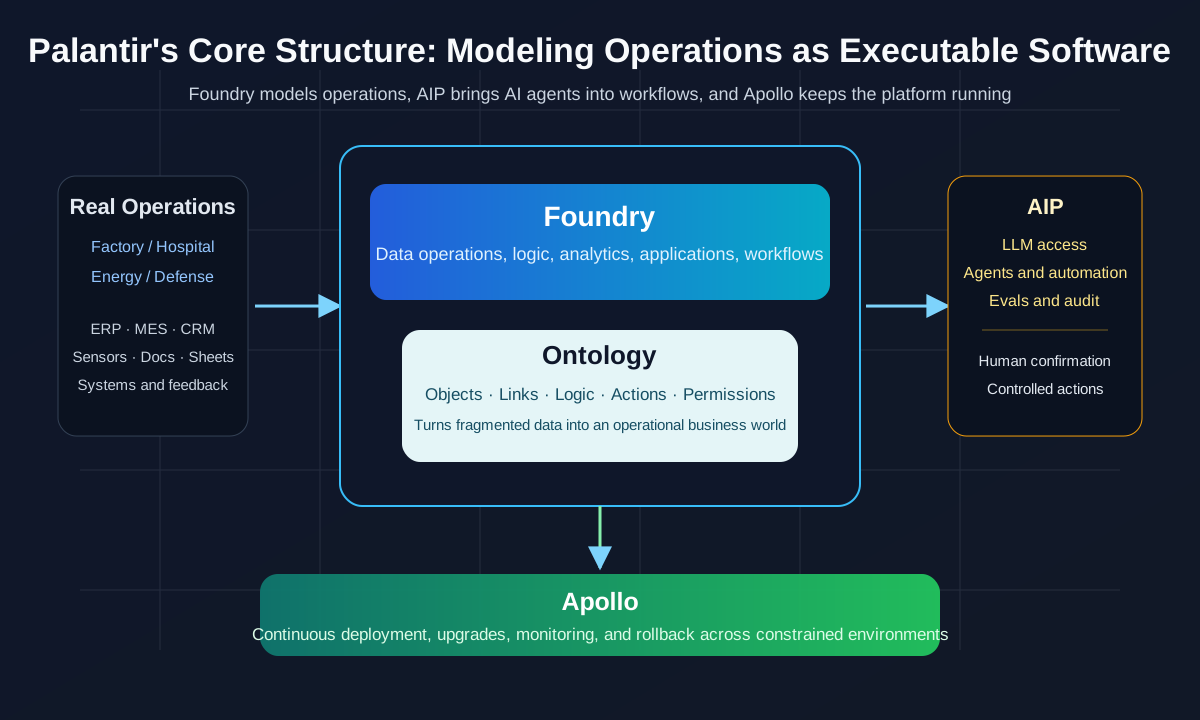
This is why Palantir’s official documentation discusses AIP, Foundry, and Apollo together as an enterprise operating system architecture. In Palantir’s current architecture, Foundry is the foundational data operations platform, AIP is the generative AI platform, and Apollo is the continuous delivery platform that runs the underlying infrastructure for Foundry and AIP.
The Three Core Platforms: Foundry, AIP, and Apollo
Start with the smallest useful map.
Foundry: Turning Enterprise Data Into an Operational World
Foundry is Palantir’s foundational data operations platform.
It is not only about syncing data from different systems. The point is to organize fragmented data into business objects that operators understand: factories, production lines, machines, work orders, materials, suppliers, customer orders, shipments, routes.
These objects are not isolated:
- An order depends on multiple materials.
- A material comes from specific suppliers.
- A supplier delay affects certain work orders.
- Work order scheduling affects production line load.
- Production line status changes delivery predictions.
Foundry’s value is that these relationships can be modeled, queried, analyzed, and operated on.
AIP: Bringing AI Into Real Business Workflows
AIP is Palantir’s generative AI platform.
When many enterprises adopt large language models, the first implementation is a chatbot: upload documents, answer questions, generate summaries. That can help, but it is still far from core operations.
Palantir AIP is more focused on putting models into workflows with permissions, context, auditability, and action boundaries.
For example, a user may ask:
If the East China warehouse is short this week, how should we adjust transfers while minimizing impact on priority customers?
A generic chatbot can give advice. AIP’s goal is different: let AI operate inside a governed environment where it can read relevant business objects, call prediction models, run optimization logic, generate candidate plans, and hand executable actions to a human for confirmation.
In other words, AIP is not mainly about whether a model can chat. It is about whether AI can participate in enterprise operations.
Apollo: Keeping Complex Software Running in Complex Environments
Apollo is easy to overlook, but it matters.
Palantir customers often run in difficult environments: cloud, on-premise networks, classified networks, edge systems, hospitals, factories, government agencies, and deployed operational settings. Software must be deployed, upgraded, monitored, rolled back, and kept running with minimal downtime.
Palantir describes Apollo as the continuous delivery platform that manages the infrastructure hosting Foundry and AIP services, orchestrating large numbers of zero-downtime upgrades.
In plain terms, Apollo answers the question: how does this software keep running under high operational constraints?
The Core Concept: Ontology
If you remember only one Palantir concept, remember Ontology.
The word can sound abstract. A more practical definition is:
The Ontology is a digital representation of the enterprise’s real operating world.
It is not just a set of database tables. It is not just a semantic layer. It needs to express at least three kinds of things:
- Objects: orders, customers, machines, flights, hospital beds, medicines, vehicles, missions.
- Relationships: which order depends on which material, which machine belongs to which production line, which patient occupies which bed.
- Actions: reschedule production, create a purchase order, change a delivery route, escalate an alert, submit an approval.
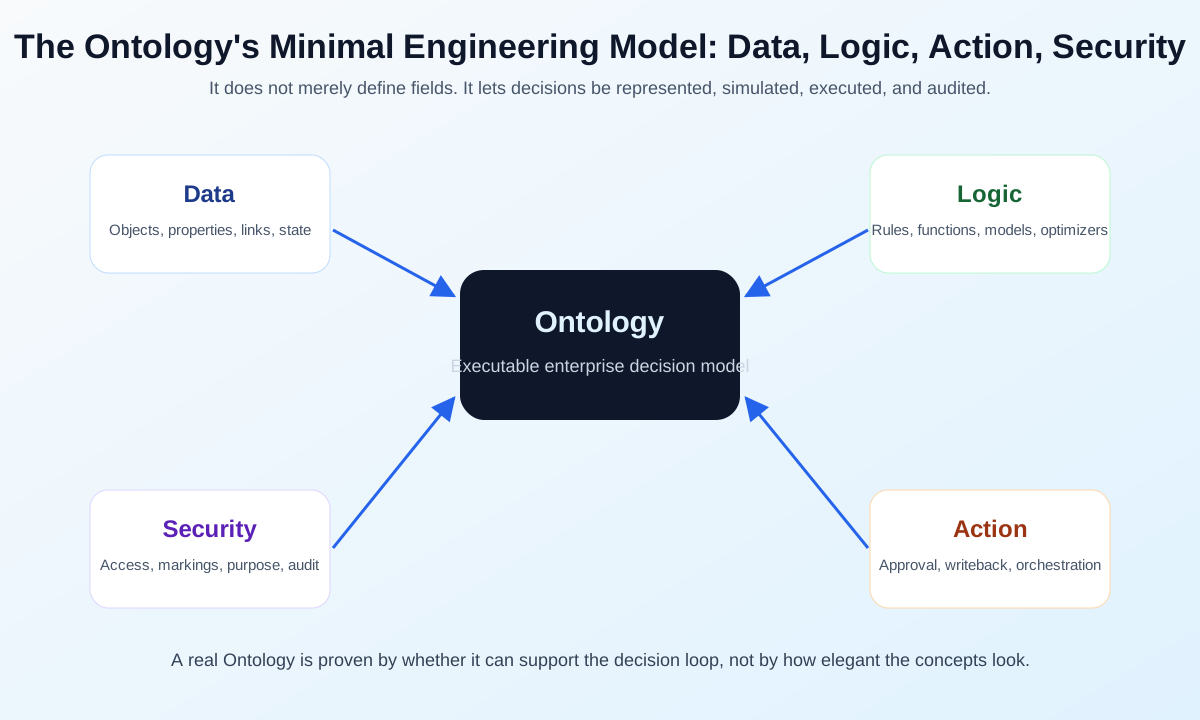
Palantir’s documentation emphasizes that the Ontology is not simply a representation of data. It is designed to represent the complex, interconnected decisions of an enterprise. It combines data, logic, action, and security so humans and AI agents can collaborate in the same operational world.
That point is important.
Many enterprise AI projects fail not because the model cannot produce text, but because the model does not know what is actually happening inside the enterprise and cannot safely take action.
The Ontology is Palantir’s answer to that missing layer.
A Simple Example: From Checking Inventory to Changing Operations
Suppose you are responsible for supply chain operations and discover that a critical material may be short.
In a traditional setup, you may have to:
- Check inventory in ERP.
- Check supplier delivery in a supplier system.
- Check work orders in the production system.
- Check customer priority in CRM.
- Export data into a spreadsheet for impact analysis.
- Hold a meeting to discuss the adjustment.
- Go back into multiple systems to execute the decision.
In Palantir’s ideal operating model, this information is connected through the Ontology:

Now AI is not giving advice from nowhere. It is assisting decisions inside an environment with business objects, permissions, logic, and action interfaces.
That is also the difference between Palantir and many enterprise knowledge-base chatbots. Palantir cares about the operational loop.
Why Palantir Often Appears in Defense, Healthcare, Manufacturing, and Energy
These domains have several things in common:
- Many data sources and complicated legacy systems.
- Decisions affect the physical world, not just a generated paragraph.
- Permission, security, and audit requirements are high.
- Workflows change frequently and cannot be captured by fixed SaaS forms alone.
- Cross-functional coordination matters more than single-tool optimization.
In these settings, buying a BI tool, an RPA tool, or a chatbot usually does not solve the root problem.
Palantir’s pitch is to put data, models, applications, permissions, and action paths into one platform. It then uses Forward Deployed Engineering, meaning engineers work close to the customer environment, to shape the platform into a system that fits the specific operational reality.
That is why Palantir does not look like a typical SaaS company. Many SaaS products sell a standardized workflow to many customers. Palantir uses a common platform to build highly customized operating systems for specific organizations.
Three Common Misunderstandings
Misunderstanding 1: Palantir Is Just Data Visualization
Visualization is only the surface.
The important part is how data is governed, modeled, connected to business objects, and then used to drive workflows and actions.
Misunderstanding 2: Palantir Is Just LLMs for the Enterprise
AIP is related to large language models, but it is not just a chatbot wrapper.
It emphasizes secure model access, connection to the Ontology, agent and automation development, and observability and evaluation for AI workflows in production.
Misunderstanding 3: Ontology Is Just a Semantic Layer
A semantic layer usually answers: what does this metric mean?
The Ontology goes further. It expresses not only metrics and objects, but also actions, permissions, and business logic. Its purpose is to support decision-making and execution.
Restating Palantir in One Sentence
Palantir is not trying to help you merely “see more data.”
It is trying to let a complex organization understand the current state, simulate options, call AI, execute governed actions, and learn from feedback inside the same digital operating world.
That is why Palantir talks about data platforms, Ontology, AIP, agents, Apollo, Forward Deployed Engineering, and the enterprise operating system in the same breath.
If you want to understand Palantir, the first step is not valuation, political controversy, or any single customer story. The first step is this architecture:
Once you understand this map, customer cases, technical architecture, business model, and valuation debates become much easier to reason about.
From an engineering perspective, Palantir’s Ontology is not a layer of business names on top of tables, and not just a reorganized metric catalog. It is an attempt to put objects, relationships, logic, actions, and permissions into one executable model, so real enterprise operations can be represented, simulated, controlled, and fed back into software continuously.
The core point is:
Palantir turns enterprise data into an operational business world, then puts AI into that world so actions can be taken under control.