Foundry is not mainly about moving more data into one place or building another BI layer. Its deeper role is to govern data, model business objects, support workflows, and connect decisions to governed writeback.
系列:Palantir Series 2 / 8
- 1 Palantir for Beginners: What Kind of Software Company Is It?
- 2 Foundry: Why Palantir Turns a Data Platform Into an Operating System 当前
- 3 Ontology: Why It Is the Core of Palantir
- 4 AIP: Why Enterprise Agents Cannot Be Just Chatbots
- 5 Apollo: Why Continuous Delivery Is a Palantir Advantage
- 6 Use Cases: How Palantir Lands in Manufacturing, Healthcare, Energy, and Defense
- 7 Business Model: Why Palantir Does Not Look Like Traditional SaaS
- 8 Controversies: Privacy, Government Contracts, Military Use, and Governance Boundaries
In the first article, I summarized Palantir this way:
Palantir turns enterprise data into an operational business world, then puts AI into that world so actions can be taken under control.
This article focuses on Foundry.
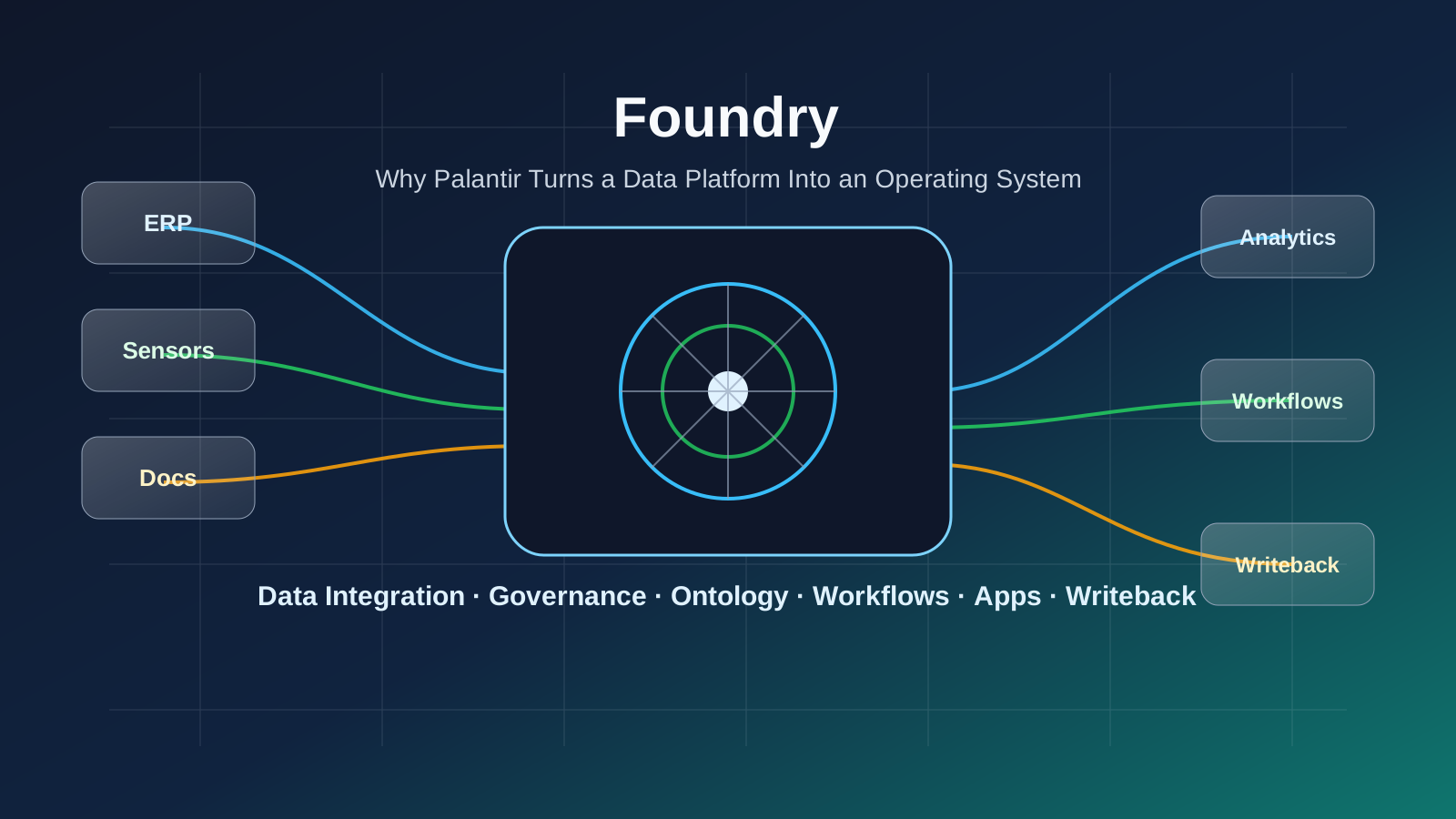
If you describe Foundry only as a “data platform,” you will miss the point. A more precise description is: Foundry is Palantir’s foundation for turning enterprise data into an operating system.
It is not just about data ingestion, storage, cleaning, modeling, or dashboards. The real chain is this:

Once this chain exists, data is no longer only a metric in a dashboard. It becomes objects, decisions, actions, and feedback inside business operations.
Why Normal Data Platforms Get Stuck at Visibility
Most enterprise data platforms begin in a reasonable way:
- Bring data from different systems into one place.
- Build a warehouse, lakehouse, or analytical layer.
- Define metrics.
- Build dashboards.
- Serve executives, business teams, and analysts.
This solves an important problem: the organization can see what is happening.
But once you enter actual operations, another problem appears:
Seeing is not the same as changing.
For example, a supply chain team may see that a key material is running short. The next steps are still manual: check suppliers, check work orders, check customer orders, calculate alternatives, discuss the decision, and then go back into ERP or another operational system to execute.
At that point the data platform is a risk-signaling system, not a risk-handling system.
Dashboards still matter. The issue is that enterprise operations need more than information display. They need an executable business model:
- Which objects are affected?
- How are those objects dependent on one another?
- Who is allowed to see, change, approve, or execute?
- Which rules and models can participate in the decision?
- Which actions can be written back to operational systems?
- How do execution results feed back into the next cycle?
Foundry’s goal is to move the data platform from observing the business to operating the business.
Foundry’s Role: A Data Operations Platform
Palantir’s documentation describes Foundry as the foundational data operations platform, providing core capabilities for data management, logic authoring, Ontology development, analytics, and workflow development.
That sentence is worth unpacking.
If you only look at data management, Foundry looks like a data platform.
If you look at logic authoring, it starts to look like an engineering platform.
If you look at Ontology development, it becomes a business object modeling system.
If you look at analytics and workflow development, it is no longer just analysis infrastructure. It is supporting operations.
Foundry is better understood as a layered data operations stack:
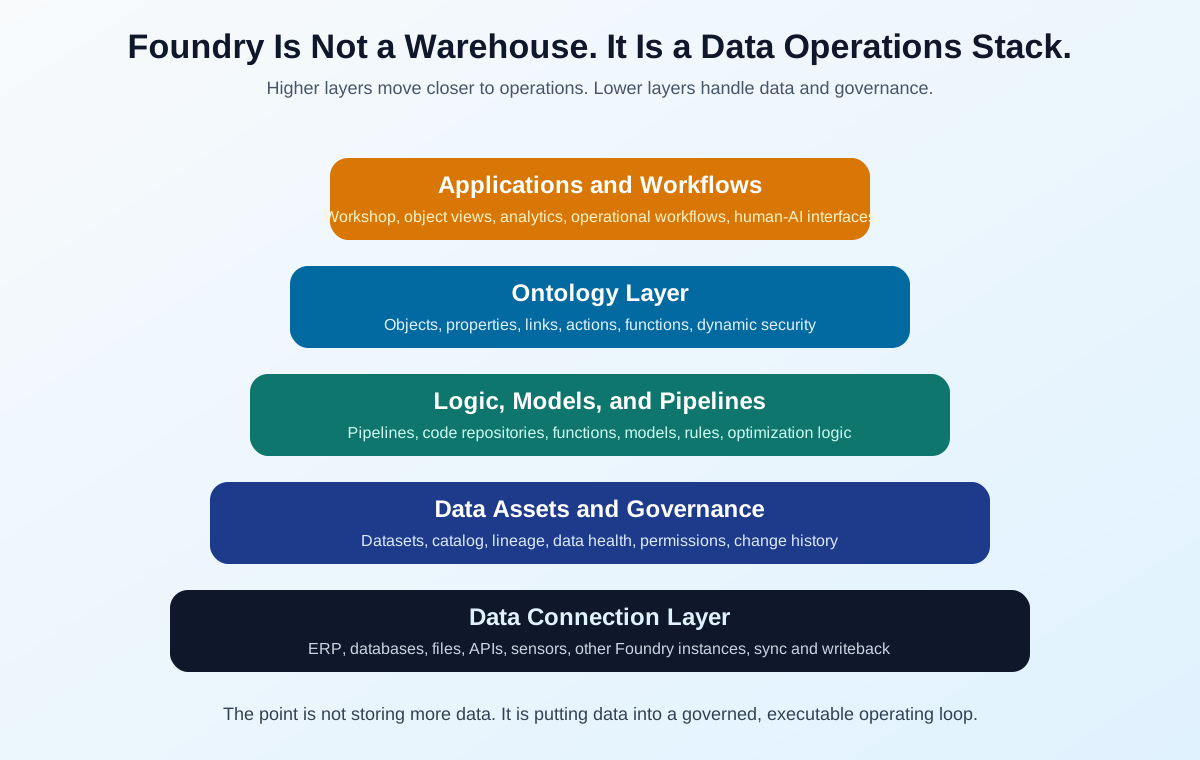
Lower layers are closer to data integration and governance.
Higher layers are closer to business objects, applications, workflows, and actions.
This is the main difference between Foundry and a conventional data platform. A conventional platform often ends at data assets and analytical consumption. Foundry pushes toward operational applications and governed action.
Layer One: Connect External Systems, But Not Just for Ingestion
Enterprise data is never cleanly stored in one place.
It may live in ERP, CRM, MES, WMS, databases, file systems, industrial sensors, geospatial systems, document systems, supplier portals, and manually maintained spreadsheets.
Foundry’s Data Connection is used to synchronize data from external systems and other Foundry instances into the platform for data integration, modeling, and Ontology layers. The official documentation also describes outbound connections through webhooks and data exports, which means Foundry can support writeback to external systems.
That matters.
Foundry’s data connection layer is not one-way movement. It exists to support modeling, governance, applications, and writeback.
Traditional ETL often means: move data into a warehouse.
Foundry asks a different question: once this data enters the platform, how does it become part of a business object and participate in operations?
Without that goal, data integration becomes endless pipeline construction. Many sources are connected, many tables are built, and only a few analysts know how to use the result.
Layer Two: Governance Is Not Compliance Decoration
In real enterprises, governance is not paperwork.
It determines whether a system can be used in production operations.
For example:
- Can frontline operators see supplier pricing?
- Can a regional manager see customer data from another region?
- Can production teams modify a scheduling recommendation?
- Can an AI agent read sensitive orders?
- Who approved an action, and when was it executed?
If a system only reads data, permissions are already complicated.
If it also supports writeback, permissions, lineage, audit, and change management become even more important.
Foundry includes capabilities around lineage, data health, cataloging, access control, and resource status. These are not just platform hygiene. They make data and downstream actions trustworthy.
A data platform without lineage and audit is only suitable as a reference system.
A platform that supports operational action must answer:
- Where did this field come from?
- Is this object state trustworthy?
- Which inputs did this model use?
- Why was this action triggered?
- Who can see, modify, approve, and roll it back?
That is why Foundry puts governance close to operations.
Layer Three: Turn Tables Into Business Objects
This is the important shift.
In a traditional data platform, the primary objects are tables, fields, metrics, jobs, and dashboards.
Operators do not think in those terms.
They think about:
- Orders.
- Customers.
- Suppliers.
- Factories.
- Machines.
- Flights.
- Hospital beds.
- Routes.
- Missions.
These are the things that exist in the operating world.
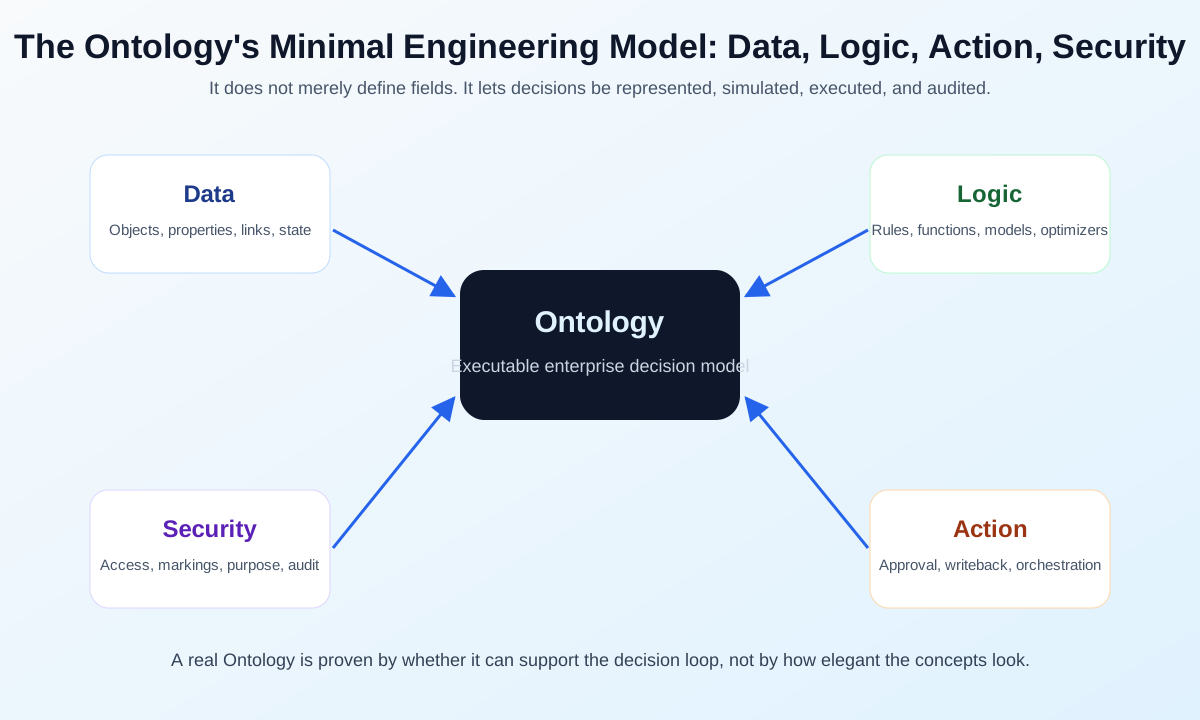
Foundry uses the Ontology to connect underlying digital assets to real-world counterparts. Palantir’s documentation describes the Ontology as sitting on top of integrated digital assets such as datasets, virtual tables, and models, connecting them to real-world entities such as plants, equipment, products, customer orders, and financial transactions.
This conversion is critical.
Agents, applications, and operators cannot operate around table names forever.
A supply chain lead should not need to ask:
What is the difference between
available_qtyandallocation_pending_qtyfor SKU 123 ininventory_snapshot_v4?
The real question is:
Which work orders can this critical material still support? If we protect Customer A, how many days will Customer B be delayed?
To answer the second question, the system must understand materials, work orders, customers, inventory, due dates, and alternative suppliers as connected business objects.
That is the role of the Ontology inside Foundry.
Layer Four: Logic Cannot Stay in People’s Heads
Many operations depend on implicit business rules.
For example:
- Class A customers have priority over Class B customers.
- Some orders cannot be partially delivered.
- Certain substitute materials can only be used on specific production lines.
- One supplier may be cheaper but carry higher quality risk.
- Some transfer plans may violate regional safety stock thresholds.
If these rules live only in experienced employees, spreadsheets, and meetings, the system cannot become reliably operational.
Foundry’s logic layer matters because it lets teams encode rules, functions, models, pipelines, and optimization logic into the platform, where they can be called through the Ontology and applications.
This is not necessarily about full automation.
Mature operating systems often begin with better decision support:
- Automatically identify affected objects.
- Calculate feasible options.
- Highlight constraints and risks.
- Show the cost of each option.
- Let a human confirm and execute.
Enterprise AI agents need this layer too.
Otherwise the model is guessing from text instead of reasoning over real business objects and verifiable logic.
Layer Five: Applications Are Work Surfaces, Not Just Dashboards
The user interface of many data platforms is a dashboard.
Foundry’s upper layer is closer to an operational workbench.
Those are different things.
A dashboard tells you what happened.
A work surface helps you complete a job.
In a supply chain scenario, a Foundry application should not merely show an inventory decline chart. It should help the user complete a loop:
- Identify the short material.
- Show affected work orders.
- Show affected customer orders.
- Generate options such as transfer, substitute purchase, or rescheduling.
- Explain cost, delivery impact, and risk.
- Let authorized users confirm.
- Write back to ERP, ticketing, or approval systems.
- Track execution results.
That is what data operations means in Foundry.
It is not a polished UI on top of a data platform. The application is built directly on the Ontology, permissions, logic, and lineage.
Why Writeback Matters
One way to judge whether a data platform has entered the operational layer is to ask whether it supports writeback.
Read-only systems explain the world.
Writable systems begin to change it.
Of course, writeback increases risk. It requires:
- Clear action boundaries.
- Strict permission checks.
- Explicit approval flows.
- Auditable execution records.
- Traceability and rollback paths.
This is why Foundry should not be understood as a stronger data warehouse.
Once the platform participates in writeback, it becomes part of the enterprise operating chain.
The engineering focus expands from query performance and dashboard experience to business safety, action governance, runtime reliability, and accountability.
The Relationship Between Foundry and AIP
AIP attracts attention because it is closer to large language models, agents, and automation.
But without Foundry, AIP can easily collapse into an enterprise chatbot.
For AI to participate in real workflows, it needs:
- Structured business objects.
- Trustworthy data context.
- Callable business logic.
- Clear permissions and action boundaries.
- Observable and auditable execution records.
These depend on Foundry and the Ontology.
Foundry is the foundation for AIP.
AIP brings AI into operations. Foundry determines whether AI is entering a reliable operating world.
If that world is fragmented, dirty, permissionless, and lacks action interfaces, even a very strong model will remain at the surface level of question answering.
The Engineering Essence of Foundry
From an engineering perspective, Foundry is not primarily about data unification. It is about operational unification.
It tries to unify:
- Business objects.
- Object relationships.
- Data lineage.
- Permission policies.
- Business logic.
- Analytics and models.
- Application interfaces.
- Action writeback.
- Feedback loops.
This is why Palantir places Foundry at the base of its enterprise operating system.
A normal data platform asks:
Where is the data? What is the metric? What is the trend?
Foundry tries to go further:
What is the current state of the business world? Which objects are affected? What actions are available? Who can execute them? How does the result feed back?
That gap is the difference between a data platform and an operating system.
When an Organization Actually Needs This Kind of System
Not every company needs something as complex as Foundry.
If workflows are simple, data sources are few, decisions have limited real-world impact, and systems are loosely coupled, a conventional warehouse, BI layer, and light automation may be enough.
Foundry becomes relevant when:
- Data sources are many and unlikely to converge into one clean system.
- Decision objects are complex and heavily interdependent.
- Actions affect the physical or operational world.
- Permission, security, and audit requirements are high.
- Cross-functional coordination is central.
- Business processes change faster than fixed SaaS workflows.
- The organization wants AI agents to participate in real operations, not just answer questions.
This is why Foundry often appears in manufacturing, energy, healthcare, supply chain, aviation, and defense.
The common denominator is not “a lot of data.”
It is complex operations.
Closing Thought
Foundry’s value is not that it moves all data into one place.
That is only the starting point.
Its deeper role is to turn enterprise data into a maintainable, governed, simulatable, and executable business system.
This is where Palantir’s data-platform story differs from many others.
A normal data platform ends by helping people see more facts.
Foundry is designed to help organizations act better on those facts.
In one sentence:
Foundry is not a data platform built for reports. It is a software foundation built for operations.
Once you understand that, the next article on Ontology becomes much easier to reason about. Foundry cannot enter the operational layer unless the enterprise’s real world is modeled first. The Ontology is the core of that model.