A serious discussion of Palantir cannot stop at technical efficiency. It must also cover privacy, government contracts, military use, concentrated data power, and AI agent governance.
系列:Palantir Series 8 / 8
- 1 Palantir for Beginners: What Kind of Software Company Is It?
- 2 Foundry: Why Palantir Turns a Data Platform Into an Operating System
- 3 Ontology: Why It Is the Core of Palantir
- 4 AIP: Why Enterprise Agents Cannot Be Just Chatbots
- 5 Apollo: Why Continuous Delivery Is a Palantir Advantage
- 6 Use Cases: How Palantir Lands in Manufacturing, Healthcare, Energy, and Defense
- 7 Business Model: Why Palantir Does Not Look Like Traditional SaaS
- 8 Controversies: Privacy, Government Contracts, Military Use, and Governance Boundaries 当前
Writing about Palantir cannot be only about product capability.
If we only discuss Foundry, Ontology, AIP, and Apollo, the story becomes a clean engineering efficiency narrative.
But Palantir’s controversies are not peripheral.
It serves governments, defense organizations, law enforcement-adjacent workflows, healthcare, energy, and large enterprises. It deals with data, decisions, action, and power.
So any serious discussion of Palantir must discuss boundaries.
The Closer Technology Gets to Action, the More Governance Matters
If a system only produces reports, the main risk is bad interpretation.
If a system affects scheduling, approvals, enforcement, healthcare resources, mission planning, and supply chain decisions, it enters the real world.
Palantir’s core capability is turning data into an operational business world.
That creates value and risk.
It does not only help organizations see. It helps organizations act.
Once software enters the action chain, the questions become:
- Who defines the objects?
- Who defines risk?
- Who can access the data?
- Who can initiate actions?
- Who is responsible for mistakes?
- Can affected people appeal or challenge outcomes?
These are not implementation details. They are governance questions.
Privacy: Not Just What Data Exists, but How It Is Used
Privacy is one of the most common concerns around Palantir.
Large organizations already have a lot of data. A platform that integrates that data increases capability.
Data that looks ordinary in one system can become sensitive when linked across systems.
For example:
- Medical records linked with location.
- Procurement data linked with supplier networks.
- Personal information linked with behavior patterns.
- Government datasets linked with operational action.
So the privacy question is not only whether data was legally obtained.
It is also:
- Is data used beyond its original purpose?
- Is there a minimum-necessary principle?
- Is access audited?
- Can the organization explain who saw what?
- Can agents be prevented from reading sensitive details?
Palantir’s documentation emphasizes permissions, security, dynamic security, and auditability. Those capabilities matter.
But technical capability is not the same as sufficient governance.
The real question is whether organizations use those controls to constrain themselves.
Government and Military Use: Efficiency and Power Must Be Considered Together
Palantir’s government and defense work is its most controversial area.
From an engineering perspective, these environments have real needs: complex data sources, constrained networks, strict permissions, urgent decisions, and real-world impact.
That helps explain why Palantir’s platform fits them.
But precisely because it fits, the controversy matters.
When software increases the decision speed of government or military organizations, it may also increase the efficiency of power.
The questions are not only technical accuracy:
- Is the use lawful and legitimate?
- Does it enable excessive surveillance?
- Does it amplify existing bias?
- Is there independent review?
- Is accountability clear?
- Is external oversight possible?
An efficient system without governance may be more dangerous than an inefficient one.
AI Agents Amplify Governance Problems
AIP brings models and agents into enterprise operations.
That makes governance harder.
Traditional software usually follows explicit rules.
Agents retrieve context, call tools, reason, generate plans, and may initiate actions.
This raises new questions:
- Why did the agent choose a tool?
- Did it miss important context?
- Did it cross a permission boundary?
- Is the recommendation biased?
- Is human confirmation meaningful or just procedural?
- How is responsibility assigned after failure?
Enterprise agents should not optimize only for automation rate.
The closer they get to real action, the more they need evaluation, observability, audit, and human boundaries.
The Ontology Is Also a Power Structure
Many people treat Ontology as a technical model.
It is not only technical.
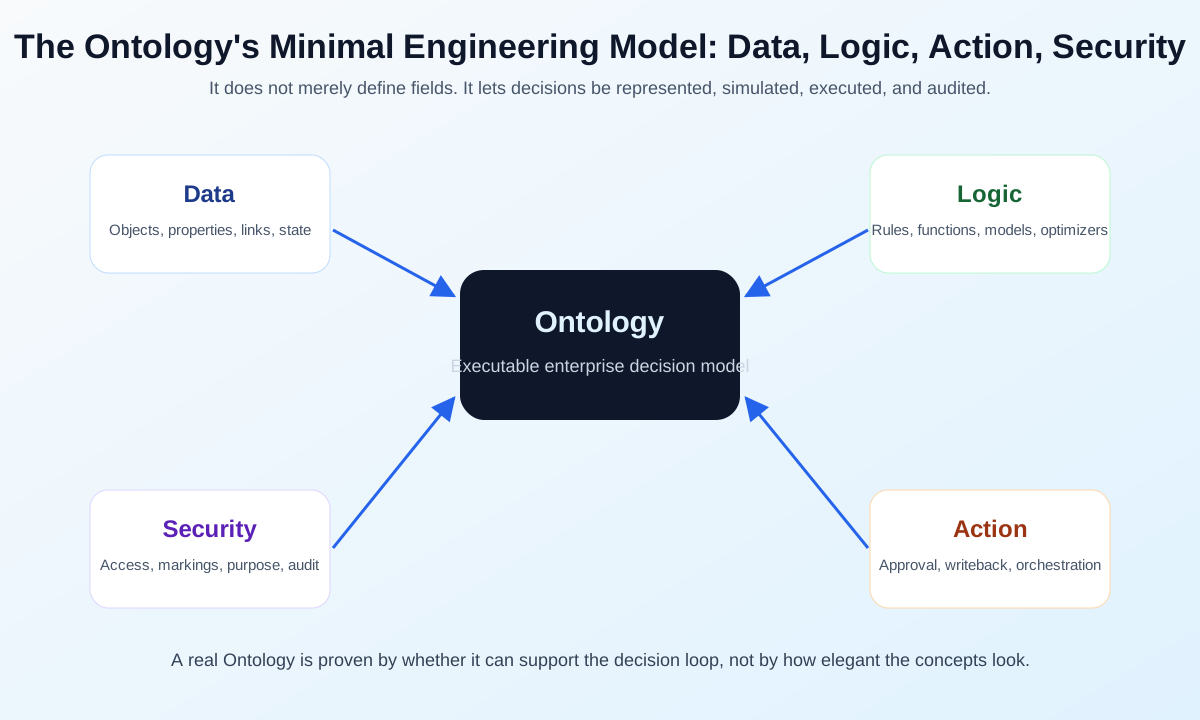
It defines how an organization sees reality:
- Which objects are modeled.
- Which relationships matter.
- Which metrics represent risk.
- Which actions are available.
- Which roles have permission.
In other words, the Ontology encodes organizational judgment and power into software.
That is both its value and its risk.
If the modeling process lacks participation and review, the Ontology can freeze one department’s worldview, ignore affected groups, or oversimplify complex reality.
A good Ontology is not only technically correct. It must be governed correctly.
A Reasonable Position on Palantir
I do not think Palantir should be discussed only through worship or rejection.
A better stance is to treat it as a high-capability, high-sensitivity software system.
It solves real problems in complex organizations.
It also enters domains that require strict organizational and social governance.
So evaluating Palantir requires two groups of questions.
Engineering questions:
- Is the system reliable?
- Are permissions fine-grained?
- Is lineage clear?
- Are actions auditable?
- Can agents be evaluated?
Governance questions:
- Is the use legitimate?
- Is data usage restrained?
- Are decisions explainable?
- Do affected people have recourse?
- Is there external oversight?
Without both sets of questions, the discussion is incomplete.
Closing Thought
Palantir is controversial not because it is “just doing data.”
The controversy exists because it connects data, models, permissions, and action deeply.
The more effective this kind of system becomes, the more governance matters.
In one sentence:
Palantir’s technical questions and governance questions cannot be separated, because its core capability is turning data into action.
That is where this series has to end. Understanding Palantir means understanding not only Foundry, Ontology, AIP, and Apollo, but also what those systems change, amplify, and need to constrain once they enter real organizations.