OpenAI previewed the GPT-5.6 family: Sol is the frontier tier, Terra is the balanced everyday tier, and Luna is the fast low-cost tier. The real shift is that model selection moves from 'which model is strongest' to 'which tier should this task be routed to'.
系列:AI Model Notes 3 / 3
- 1 baidu/Unlimited-OCR: A New Option for Long-Document OCR
- 2 Claude Sonnet 5: A More Agentic Sonnet Model
- 3 GPT-5.6 Sol, Terra, and Luna: OpenAI Splits Agentic Coding Into Three Tiers 当前
OpenAI previewed the GPT-5.6 family: Sol, Terra, and Luna.
The most important part is not just “another stronger model.” It is that OpenAI is explicitly splitting agentic coding models into three tiers: one frontier model, one everyday balanced model, and one fast low-cost model.
The model list in Codex gives them direct positioning:
- gpt-5.6-sol: Latest frontier agentic coding model.
- gpt-5.6-terra: Balanced agentic coding model for everyday work.
- gpt-5.6-luna: Fast and affordable agentic coding model.
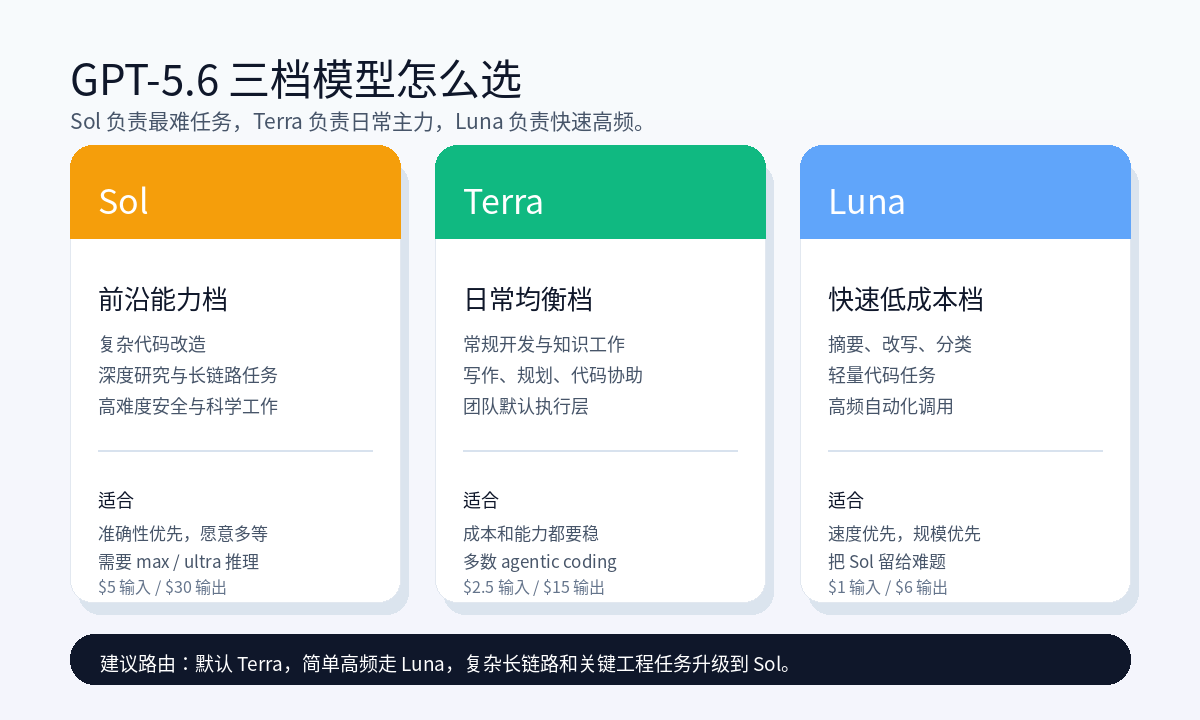
In product terms: Sol handles hard problems, Terra handles mainline work, and Luna handles speed and scale.

The Short Version
The real shift in GPT-5.6 is that model choice moves from “use the strongest by default” to “route by task.”
Teams used to ask one question when choosing models: which model is strongest?
Agentic coding has a different cost structure. A real engineering task may include reading code, searching references, editing files, running tests, fixing failures, and writing summaries. Sending every step to the strongest model may not improve results much, but it quickly increases cost and latency.
The three-tier GPT-5.6 structure looks more like an engineering queue:
- Simple, repetitive, high-frequency tasks go to Luna.
- Everyday development, writing, research, and planning go to Terra.
- Truly complex, critical, long-reasoning tasks escalate to Sol.
If you build AI coding tools, internal automation agents, or developer assistants, the key is not routing everything to Sol. It is designing reasonable task routing.
Sol: The Frontier Tier for the Hardest Engineering Problems
GPT-5.6 Sol is the flagship model in this release.
OpenAI describes Sol as its strongest model and emphasizes improvements on agentic tasks such as coding, biology, and cybersecurity. For developers, two points matter most.
First, Sol targets complex coding workflows. OpenAI mentioned improved performance on Terminal-Bench 2.1, which evaluates command-line workflows involving planning, iteration, and tool coordination, not just single-function completion.
Second, Sol introduces heavier reasoning configurations. OpenAI mentions a new max reasoning effort and an ultra mode that uses subagents for complex work. This positions Sol as a “hard task processor”: it shines when the problem requires multi-round investigation, multi-file changes, and long-chain verification.
Sol is suitable for:
- Cross-module code changes.
- Investigating and fixing hard-to-reproduce bugs.
- Reviewing large PRs and suggesting refactors.
- Technical research requiring a lot of context.
- High-value, low-tolerance agentic coding tasks.
But Sol should not be the default for every task. It is more expensive and better reserved for problems where waiting longer is worth it.
Terra: The Default Work Model for Most People
GPT-5.6 Terra is the most “everyday” model of the three.
OpenAI positions Terra as a balanced model for everyday work. The help center describes it as a strong model at lower cost, and the release page says Terra is competitive with GPT-5.5 while costing half as much.
This kind of model is often the most important one. Real work is usually not all extreme problems. It is a large volume of medium-complexity tasks:
- Implementing a first version from requirements.
- Reading a project and explaining structure.
- Drafting technical plans.
- Writing tests and fixing routine failures.
- Summarizing meetings or product documents.
- Breaking an idea into executable steps.
If you need a default agentic coding model for a team, Terra is likely the starting point. Its value is not winning every benchmark, but balancing “strong enough, fast enough, and affordable enough.”
A practical default is: use Terra by default, escalate to Sol when complexity requires it.
Luna: The Lightweight Tier for Speed and Scale
GPT-5.6 Luna is the fastest and cheapest tier.
This kind of model is easy to underestimate because it is not the flashy part of a launch. But in real systems, low-cost models determine whether agents can scale.
Luna is suitable for:
- Summarization, rewriting, classification, and tagging.
- Log pre-screening and alert explanation.
- Simple code snippet generation.
- Batch document processing.
- Lightweight questions in high-frequency user interactions.
- Preprocessing or routing before a complex task.
In a mature agent system, Luna can first estimate task difficulty, extract key information, and organize context. Only when the task escalates should the system call Terra or Sol.
This makes the system look more like an engineering system, not a single big-model call.
The Pricing Signal Is Clear: OpenAI Wants Layered Usage
OpenAI’s help center lists API prices per 1M tokens:
| Model | Input | Output | Positioning |
|---|---|---|---|
| GPT-5.6 Sol | $5.00 | $30.00 | Strongest, best for complex tasks |
| GPT-5.6 Terra | $2.50 | $15.00 | Everyday balance |
| GPT-5.6 Luna | $1.00 | $6.00 | Fast, low-cost, high-frequency |
The price gradient itself is product guidance: do not send everything to the most expensive model.
For coding agents, output tokens often get out of control faster than input tokens because the model writes plans, reads logs, edits code, explains failures, and summarizes results. Sol’s output price is five times Luna’s, directly affecting the marginal cost of automated workflows.
Teams should do three things early:
- Classify tasks: lightweight, regular, complex.
- Assign a default model to each level.
- Track failure rate, escalation rate, latency, and cost.
Model routing will become a basic capability in AI engineering systems.
Availability: Do Not Treat Preview as Full Release
As of July 10, 2026, OpenAI’s public notes contain two layers of information.
First, GPT-5.6 Sol, Terra, and Luna are in limited preview. API and Codex access are for a small number of trusted partners and organizations. The OpenAI help center previously stated there was no public application or waitlist.
Second, OpenAI later updated ChatGPT-side documentation: GPT-5.6 Sol is gradually rolling out to eligible ChatGPT plans; Terra and Luna are not directly selectable in standard ChatGPT conversations, but can be used in Work, Codex, API, and other contexts depending on plan and workspace permissions.
So for ordinary users: not seeing the model does not mean your setup is wrong, and it does not mean every entry point has opened.
For developers, Codex CLI also has a minimum version. The help center lists Codex CLI 0.144.0 as the minimum.
What This Means for Development Teams
GPT-5.6’s three-tier structure will push coding agents from “single-model experience” to “multi-model scheduling.”
A practical strategy:
- Luna handles the entry layer: summarization, classification, simple Q&A, task difficulty estimation.
- Terra handles the execution layer: most code changes, documentation, analysis, and routine automation.
- Sol handles escalation: complex architecture, critical fixes, cross-system reasoning, and high-risk tasks.
This creates a new product question: when should the system escalate automatically?
Common escalation signals include:
- The task spans multiple repos or systems.
- Tests fail repeatedly and the root cause is unclear.
- A large amount of historical context is needed.
- The user explicitly asks for high accuracy.
- The operation may affect production.
- The model judges that deeper reasoning is required.
Future AI coding products may differ not only in which model they use, but in when they use which model.
Safety and Governance Cannot Be Skipped
OpenAI emphasizes in its release materials and system card that GPT-5.6’s capability improvements come with a stronger safety stack, especially for high-risk cybersecurity and biology requests. Stronger models can help defenders find and fix vulnerabilities, but they also increase abuse risk.
This matters for enterprise agent deployment.
Upgrading the model without upgrading governance is dangerous. At minimum, teams need:
- Tiered tool permissions.
- Human confirmation for high-risk actions.
- Audit logs for terminal, browser, repositories, and production systems.
- Isolation and detection for prompt injection.
- Output validation and rollback mechanisms.
- Minimal exposure of sensitive data.
The goal of agent coding is not to let models “act freely.” It is to let models do more work inside clear boundaries.
Takeaway for Development Teams
The release of GPT-5.6 Sol, Terra, and Luna marks a clearer productization stage for OpenAI’s agentic coding models.
Sol represents the ceiling, Terra represents default productivity, and Luna represents scalable cost.
For individual users, the experience may be: complex tasks feel more stable, and the model behaves more like an assistant that can move work forward.
For development teams, the real opportunity is treating models as schedulable resources instead of one fixed button.
Over the next period, the core competitiveness of AI coding tools will shift from “integrating the strongest model” to “assigning tasks to the right model and escalating reasoning strength when needed.”