Claude Sonnet 5 is Anthropic's next-generation Sonnet model, with stronger reasoning, tool use, coding, and long-horizon task execution. It narrows the gap with Opus 4.8 in agentic scenarios while covering more everyday development and knowledge-work tasks at a lower price.
系列:AI Model Notes 2 / 3
- 1 baidu/Unlimited-OCR: A New Option for Long-Document OCR
- 2 Claude Sonnet 5: A More Agentic Sonnet Model 当前
- 3 GPT-5.6 Sol, Terra, and Luna: OpenAI Splits Agentic Coding Into Three Tiers
Anthropic released Claude Sonnet 5.
The keyword for this upgrade is not “better chat.” It is more agentic: better at making plans, calling tools, using browsers and terminals, and pushing multi-step tasks forward instead of stopping halfway.
If Claude Sonnet 3.5, 3.6, and 3.7 made many developers feel that models could write code, use tools, and assist development, Sonnet 5’s significance is that it pushes previously Opus-like agentic capability down into the lower-cost Sonnet tier.
Core Takeaway
Claude Sonnet 5 is a cost-effective model for agent coding and everyday automation.
It is not Anthropic’s strongest model. Opus 4.8 is still more suitable for the most complex, critical, deep-reasoning tasks. But Sonnet 5’s value is that in many agentic workflows, it gets close to Opus 4.8 while costing much less.
That means it may become the default execution-layer model for many teams.
What Improved?
Anthropic describes Sonnet 5 as its most agentic Sonnet model so far.
The improvements mainly show up in:
- Stronger reasoning: more stable planning and judgment in complex tasks.
- Stronger tool use: better for browser, terminal, code tools, business systems, and multi-tool workflows.
- Stronger coding: better at multi-step software engineering work, not just code snippets.
- Stronger knowledge work: better for research, analysis, search, organization, and synthesis.
- Stronger long-horizon follow-through: better at moving tasks from start to verification instead of stopping midway.
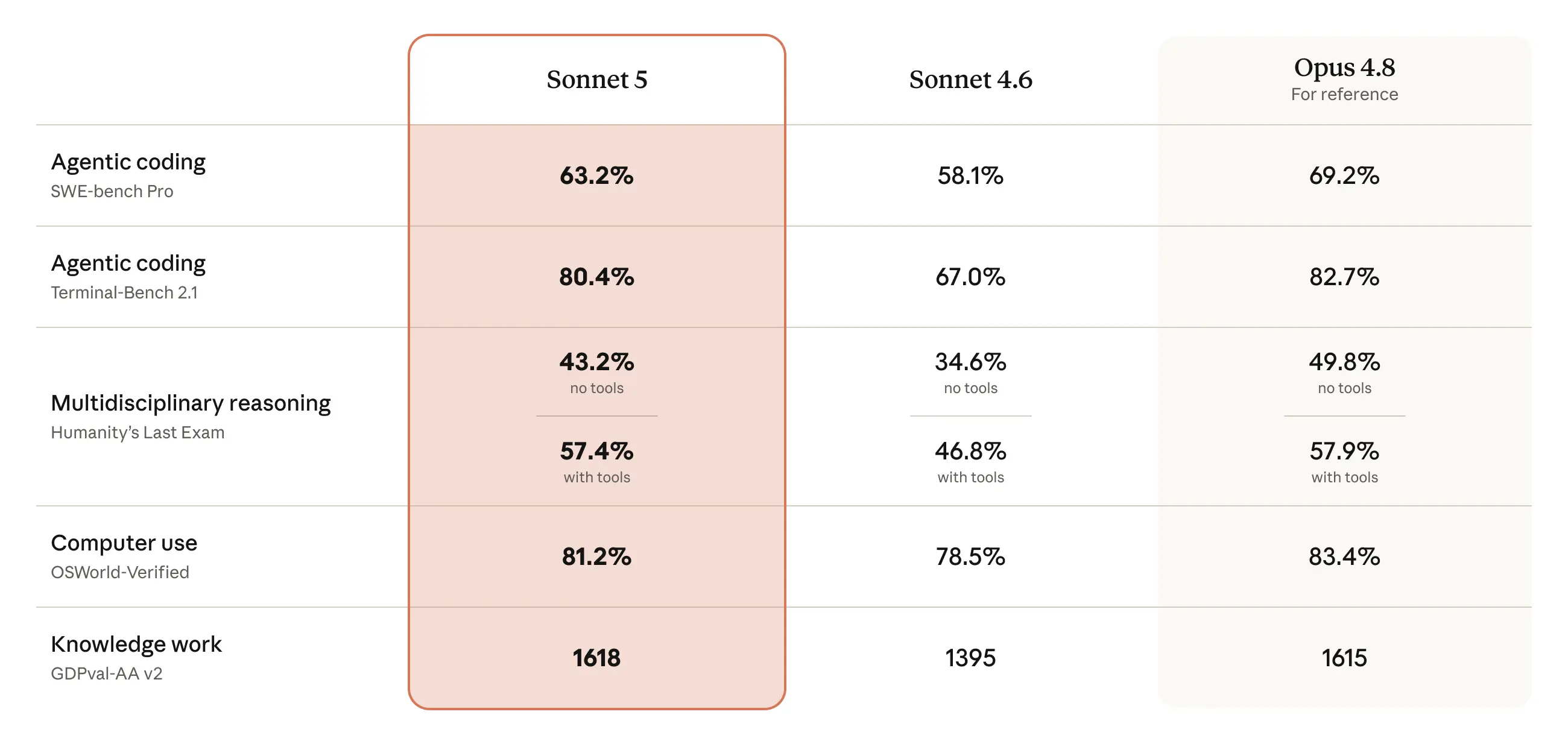
From Anthropic’s comparisons, Sonnet 5 improves clearly over Sonnet 4.6 across multiple evaluations and approaches Opus 4.8 in some agentic scenarios.
More importantly, it covers a wider cost-performance range. Users can adjust reasoning intensity with effort levels and find a balance between cost and quality.
Why It Matters for Agent Coding
Agent Coding is not about whether a model can write one function. It is about whether it can complete an engineering chain:
- Understand the goal.
- Read existing code.
- Make a modification plan.
- Implement code.
- Call tools to verify.
- Fix errors after observing failures.
- Produce a reviewable result.
The problem with many previous Sonnet-tier models was that they worked well for single steps but often stopped halfway through long workflows.
For example:
- They wrote code but did not run tests.
- They found a bug but did not write a reproduction.
- They fixed a surface issue but did not confirm root cause.
- They automated the first half and left the rest to humans.
- They forgot the original plan when context became complex.
Sonnet 5 improves exactly in these areas.
Early feedback from teams mentions stronger end-to-end task completion: continuous coding, tool use, debugging, messy technical context, real PR fixes, and root-cause tracing in brownfield code. This suggests the improvement is not just benchmark movement; it is closer to real development workflows.
Good Fits
Based on positioning and capability, Sonnet 5 is well suited for:
1. Everyday Agent Coding
Including:
- Small to medium feature development.
- Bug investigation and fixes.
- Writing tests.
- Refactoring local modules.
- Reading project code and proposing a change plan.
- Handling real PRs.
If the task requires the model to read code, run commands, fix failures, and verify again, Sonnet 5 is a better fit than previous Sonnet models.
2. Multi-Step Automation
For example:
- Update CRM data and send notifications.
- Read internal systems and organize reports.
- Execute business operations and generate records.
- Move, verify, and summarize information across tools.
The key is not one-shot answer quality, but follow-through: can the model finish the process?
3. Knowledge Work and Research
Including:
- Searching sources.
- Comparing documents.
- Organizing evidence.
- Writing analysis reports.
- Summarizing long text.
- Producing decision recommendations from material.
Sonnet 5’s improvements in tool use and knowledge work make it suitable as a research assistant.
4. Medium-Complexity Business Agents
For example:
- Preliminary legal document research.
- Data analysis assistants.
- Insurance process automation.
- Customer support assistance.
- Internal operations automation.
This requires permission control, auditing, human confirmation, and safety boundaries.
Poor Fits
Sonnet 5 is strong, but not every task should use it.
1. Very High-Risk Decisions
For money, legal liability, medical decisions, security incidents, and production changes, Sonnet 5 can assist analysis but should not decide automatically.
2. The Most Complex Reasoning Tasks
If a task needs the highest reasoning, longest planning horizon, or strongest coding capability, Opus 4.8 may still be better.
3. High-Risk Cybersecurity Tasks
Anthropic states that Sonnet 5 was not deliberately trained for cybersecurity tasks. It can perform some routine benign cyber tasks, but is clearly weaker than Opus-tier models on dangerous cyber capability evaluations.
Anthropic also enables real-time cyber safeguards by default for Sonnet 5.
This means it is not a model for advanced offensive-defense automation.
4. Agents Without Tools and Verification Loops
Sonnet 5’s value comes from tool use and long-horizon execution. If your system does not provide browser, terminal, tests, databases, business APIs, or other tools, its agentic capability is constrained.
Using it only as a chat model wastes its main advantage.
Safety Evaluation
Anthropic’s safety conclusion is fairly clear:
- Sonnet 5 is overall safer than Sonnet 4.6.
- It is better at refusing malicious requests in agentic safety.
- It resists prompt-injection hijacking better.
- It has lower hallucination and sycophancy tendencies than Sonnet 4.6.
- In automated behavior audits, its overall undesirable behavior rate is lower than Sonnet 4.6.
But that does not mean safety is solved.
Anthropic also notes that in some undesirable-behavior evaluations, Sonnet 5 still has a higher rate than stronger models such as Opus 4.8 and Claude Mythos Preview. Real product deployments cannot rely only on the model. They need:
- Permission isolation.
- Tool-call auditing.
- Secondary confirmation for high-risk actions.
- Prompt-injection defenses.
- Output validation.
- Minimal exposure of sensitive data.
For agent systems, model safety is only the first layer. System governance is the key.
Pricing and Availability
According to the original materials, Claude Sonnet 5 is available across plans:
- Free and Pro use Sonnet 5 by default.
- Max, Team, and Enterprise users can access it.
- Claude Code can use it.
- Claude Platform can use it.
- API model name:
claude-sonnet-5.
Pricing:
| Period | Input price | Output price |
|---|---|---|
| Introductory pricing before 2026-08-31 | $2 / million input tokens | $10 / million output tokens |
| Standard pricing afterward | $3 / million input tokens | $15 / million output tokens |
One detail matters: Sonnet 5 uses an updated tokenizer, so the same input may map to more tokens. Anthropic gives a range of around 1.0-1.35x, depending on content type.
Anthropic says introductory pricing is designed to keep migration cost from Sonnet 4.6 to Sonnet 5 roughly neutral.
How to Choose: Sonnet 5 or Opus 4.8?
Choose by task complexity and risk:
| Scenario | Recommendation |
|---|---|
| Everyday coding, bug fixes, tests | Sonnet 5 |
| Multi-step automation, internal business agents | Sonnet 5 |
| Cost-sensitive large-volume agentic tasks | Sonnet 5 |
| Complex architecture, critical reasoning, hard problems | Opus 4.8 |
| High-risk security, legal, production decisions | Opus 4.8 + human review |
| Fast exploration with selective escalation | Start with Sonnet 5, escalate to Opus 4.8 when needed |
A safer engineering strategy:
- Use Sonnet 5 as the default execution layer.
- Escalate to Opus 4.8 when tasks are complex, failure cost is high, or stronger judgment is needed.
- Use effort levels to balance cost and quality.
- Add permissions and audit logs to all tool calls.
Practical Meaning for Developers
Sonnet 5 shows that agentic AI capability is moving from flagship-only models into cheaper default models.
This has three effects.
First, Agent Coding cost decreases. Long workflows that previously required expensive models can now start with Sonnet 5.
Second, AI automation can cover more scenarios. CRM, internal systems, data analysis, and knowledge-work workflows can use Sonnet 5 as an execution layer.
Third, teams need to redesign model routing. Not every task should use the strongest model. Route dynamically by difficulty, risk, and cost.
My Take
Claude Sonnet 5 is a model worth watching closely.
Its core value is not one isolated capability jump. It brings stronger agentic capability into a lower-cost tier. For software development, tool use, multi-step automation, and knowledge work, it may become the new default.
It is suitable for:
- The execution layer of Agent Coding.
- Everyday development assistants.
- Internal business automation agents.
- Research and knowledge-work assistants.
- Cost-sensitive large-scale tool-calling tasks.
But it should not be understood as a model that fully replaces human decision-making. The more agentic a model is, the more it needs system-level permissions, validation, auditing, and human confirmation.
In one sentence:
Sonnet 5 makes “AI that can do work” cheaper and more common, but reliable agents still depend on the combination of model, tools, process, and safety boundaries.
References: